By Kenzie Love
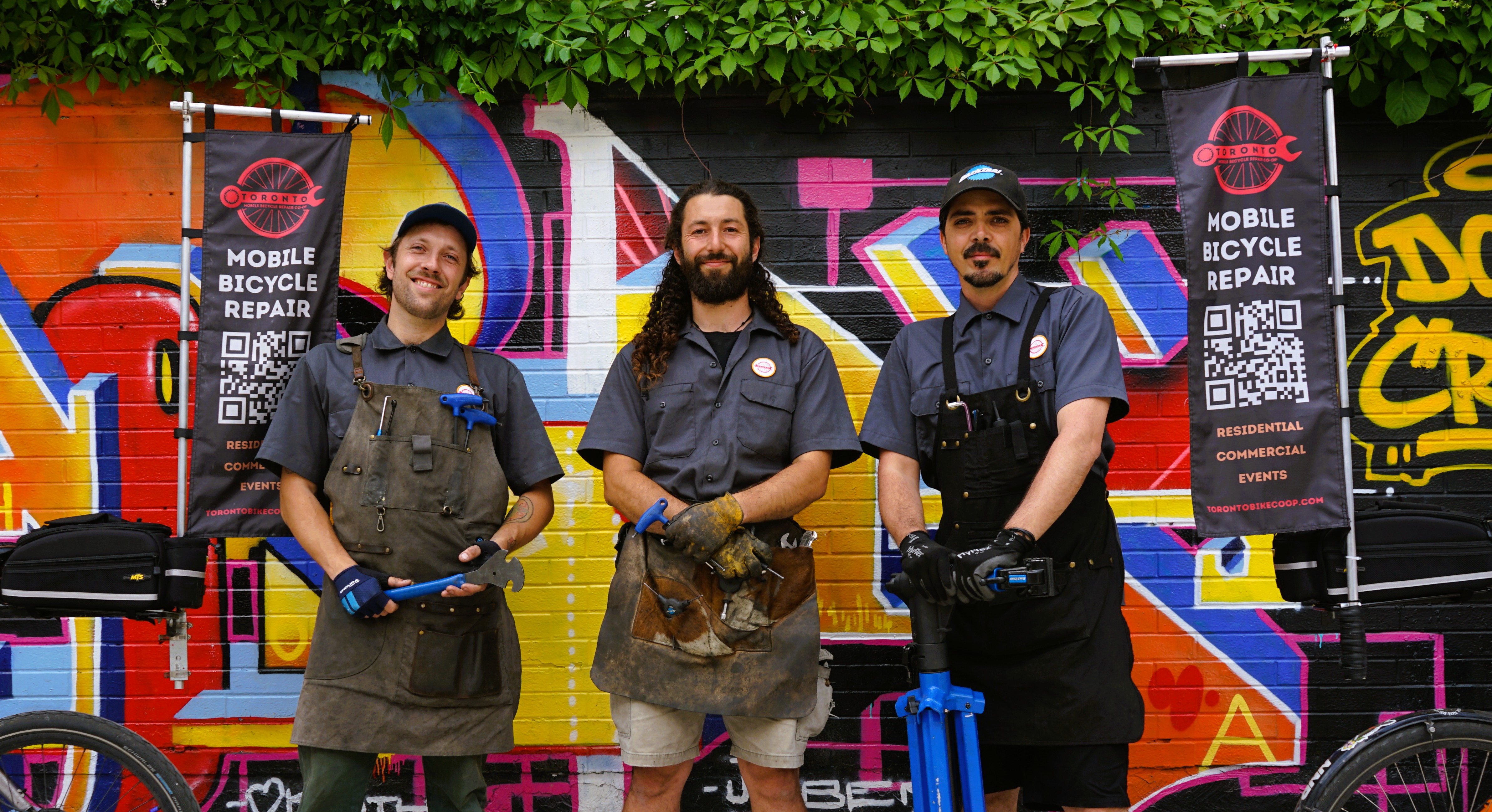
Even as a sole proprietor, Matteo Zammit never wanted to feel like a boss. After starting out on his own, the Toronto bike mechanic had recruited others to join him when his business expanded, but maintained a relatively flat organizational structure. So when his two coworkers suggested transitioning to a worker co-op, Zammit was open to the idea. Looking back two years later, it’s a decision he’s glad he made.
“It’s not like I treated my friends like employees,” he says. “I always wanted it to feel the way it feels now, even though legally it’s changed. But now that it’s co-owned, it’s been really cool for me to see everyone’s energy in their own way, with their own skill set and their own talents being poured into the project so much more.”
Toronto Mobile Bike Repair Co-op benefited in the transition from the support of others within the co-op community. A technical assistance grant from CWCF helped with the practical details of converting to a worker co-op, and members of SendIt Courier and Urbane Cyclist were also happy to offer advice, something Julien Abraham, another cofounder, appreciated.
“I’ve opened a few businesses before which were more on the classical side of things,” he says. “And it’s a very different environment, where it’s more competitive and guarding secrets on how you’re building your business, and it was refreshing to be in this environment where it was co-operation rather than competition.”
Learning how to co-operate within the Co-op has sometimes been a challenge, says Abraham, though he believes that the decision to govern by consensus is a strength of the worker co-op model as well.
“We spend a lot of time trying to figure out where we are comfortable, and how we want to interact with each other, and still get stuff done,” he says. “It’s sometimes much easier to have someone say, ‘hey, I want it like this.’ And that’s why a lot of businesses are run like that. Whereas in the co-op, it’s just a much bigger process to make decisions. And I think that’s the biggest challenge, and also probably the most rewarding part, for me anyways, at the same time, is to see when you open up that conversation what people bring in that you might not have thought of.”
Going forward, the Co-op hopes to bring on more members and expand its client base. Zammit believes Toronto Mobile Bike Repair can serve as an example of how its sector would function in an ideal world.
“The most important cool things that we’re able to do are to facilitate and economize bicycle repair to help cities be more bicycle-friendly,” he says. “We’re always going to need bike shops, but the majority of the work that a bicycle needs does not need to go to a shop. The bike mechanic can show up, and it can be so much easier for that cyclist. I really would love to see this business model highlighted to the world around us.”