By Kenzie Love
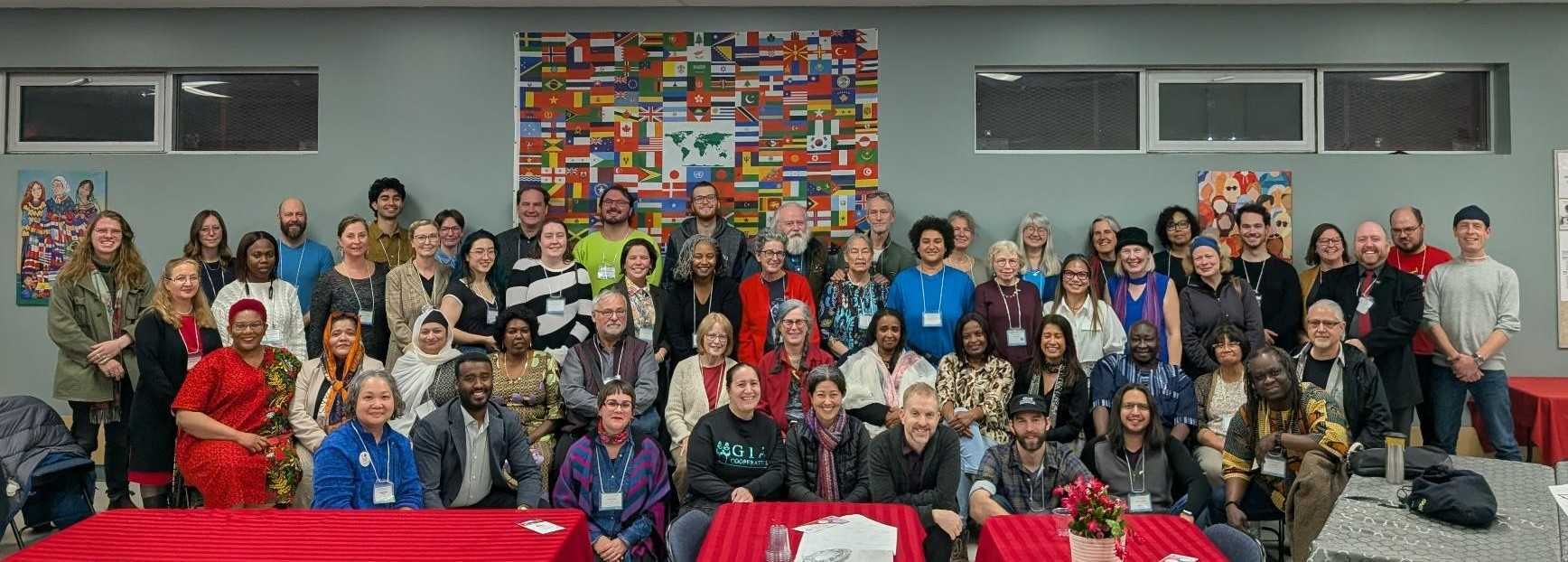
Over 50 worker co-operators from across Canada gathered in Edmonton, November 18-20, for CWCF’s annual Conference, with a theme of Worker Co-ops Build a Better World: Democracy, Diversity, and Justice. The Conference featured compelling presentations and great networking opportunities, and an impromptu dance party that broke out after the awards ceremony. Throughout the event, there was the buzz that comes from gathering, however briefly, with people who share the same values and goals.
Juliet ‘Kego Ume-Onyido observed in her compelling keynote address that if “you’ve never lived without something, you don’t know how powerful that thing is;” it was a stark reminder that democracy is something many of us have taken for granted. At the same time, despite advances in democracy during the 20th century which are now under attack, she observed that it has advanced relatively little in the world of work, despite this being a central part of much of our identity. But establishing democracy in the workplace has the potential to generate a ripple effect, since most systems of oppression are rooted in economic injustice. She also reminded us that diversity is a super-power, with each of us asked to look at where we fit on the wheel of power and privilege, to recognize connections and to yield energy to others.
The Conference served as a model for how democracy can function in our co-ops and in the wider world. Sunflower Facilitation and Consulting Co-op’s session on co-regulation & co-operation demonstrated how better decisions are made when everyone has a say and all objections are valued. Camille Dumond of Waterline Co-op showed how the conflicts that will inevitably arise can be embraced rather than feared. And the session by Multicultural Health Brokers on participatory governance was a reminder of the wealth of cultural knowledge present within immigrant communities.
With participants hailing from Vancouver to the Maritimes, the conference also served to illustrate the diversity that exists within the Canadian worker co-op movement, and the gaps that still remain. The relative absence of younger participants among the attendees didn’t go unnoticed, and as ‘Kego Ume-Onyido observed, a stronger youth presence within the movement is critical to ensuring its continued survival. The presentation by Julia Fursova, Emma Shaikh, and Kisa Hamilton, meanwhile, highlighted the challenges that continue to face members of equity-denied groups within the sector, whose networks are socially rich but structurally undersupported. This presentation was on the project led by Julia Fursova of the University of New Brunswick (in which CWCF is partnering), researching the needs of equity-denied groups for worker co-op development.
The Conference didn’t dismiss the scale of the challenges facing the worker co-op movement. Colin MacDougall put it well in his acceptance speech on receiving the Mark Goldblatt Worker Co-op Merit Award when he remarked that “the magnitude of what we’re trying to do as a sector is humbling.” And yet those present showed a willingness to confront these challenges and a recognition that they can only be addressed by coming together, both within and beyond this sector. The Conference helped participants resonate with the quote of Arundhati Roy, noted in the keynote address, that “a better world is not only possible, she is on her way. On a quiet day, I can hear her breathing.