By Kenzie Love
In recent years, there’s been a growing consensus that infinite economic growth, the basis for the capitalist economy, is inconsistent with the finite resources of a fragile planet, one in which a dramatic reduction in greenhouse gas emissions is urgently needed. But as Hettie O’Brien noted in a 2023 article, “there are few templates for an economy that radically shrinks the world’s carbon footprint without also shrinking our quality of life.”
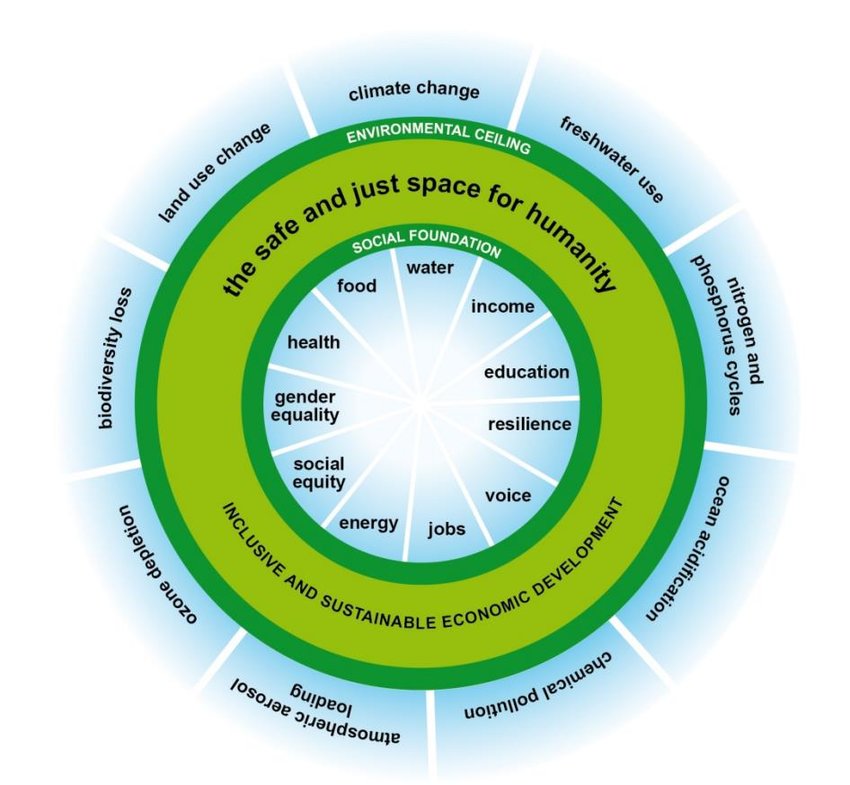
That’s why, almost a decade after its initial publication, there continues to be buzz around Kate Raworth’s 2017 book Doughnut Economics: Seven Ways to Think Like a 21st Century Economist, which seeks to lay out a model for precisely that shift. Raworth’s framework for a sustainable economy, as outlined in the book, is based on the shape of a doughnut. “At its conceptual core, the Doughnut consists of two concentric rings: a social foundation, to ensure that no one is left falling short on life’s essentials, and an ecological ceiling, to ensure that humanity does not destabilize the life-supporting systems that sustain all life on Earth. Between these two sets of boundaries lies a doughnut-shaped space that is both ecologically safe and socially just: a space in which humanity can thrive.”
At first glance, this model certainly seems desirable in spite (or more likely because of) how different it is from the current economic system. But for all the buzz it’s received, doughnut economics has also attracted its share of critics, some of whom argue her ideas are less groundbreaking than the theory’s supporters would have one believe. As Jordan G. Teicher argues, Raworth seemingly contends that “up until recently, no one had thought to pursue an economy in which everyone’s basic needs were met, or in which humanity’s demand for ecological resources didn’t exceed the earth’s regenerative capacities.”
While Raworth’s introduction of doughnut economics may have created a new framework for the ideas she espouses, Teicher is correct that the ideas themselves aren’t new, with one longstanding expression of them being, of course, the seven co-operative principles. But while there would seem to be a natural affinity between these principles and doughnut economics, there’s been relatively little research on the topic.
A 2022 article investigated how worker co-ops can contribute to a more sustainable economy by studying six British worker co-ops through the doughnut economics lens, concluding that “the overarching implications of this enterprise model for sustainability show how a business founded in shared ownership can provide a decent life for employees and the community in which it resides, without jeopardising ecological health.” The article found the worker co-ops studied also had some shortcomings however, notably in the need for them “to move past causing less damage into restoring living systems,” and also that worker co-ops remain, in the UK and many other countries, “a rarity.”
The question of how worker co-ops can become a transformational presence in the global economy remains a central one for the sector. But there’s no question that such a shift is a part of the answer to helping the world fit within the doughnut, and that such a world is critical to a sustainable future.