By Kenzie Love
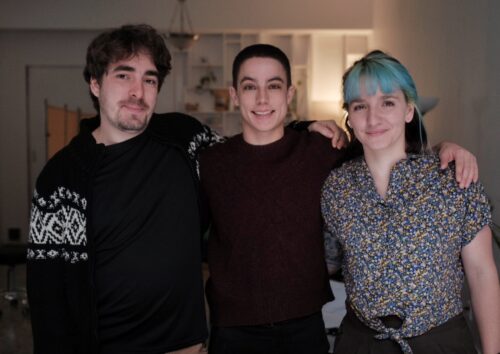
Founded in 2022, Clinique d’Acupuncture Sociale d’Hochelaga reflects its founders’ vision of an acupuncture clinic rooted in accessibility, affordability, and solidarity. Located in Montreal, the clinic is a trailblazer in Quebec, as the first community acupuncture clinic in the province and also its first acupuncture clinic established as a worker co-op.
“We chose to open up as a worker co-operative because it feels like it really corresponds with our mission,” says cofounder Félix Dénommé. “We’re a nonprofit organization and our goal is to make acupuncture and traditional Chinese medicine as affordable as possible, and working together as a co-operative helps us accomplish that goal.”
The clinic’s focus on community acupuncture is central to its mission. In contrast to traditional acupuncture, which takes place in a private setting, community acupuncture involves treating several people simultaneously in an open space, dramatically reducing costs. While a private acupuncture session might cost as much as $120, the Co-op charges on a sliding scale of just $20-$60 a session, making treatment accessible to many people who couldn’t afford it otherwise. By offering flexible pricing, wheelchair accessibility, and a commitment to members of marginalized groups, the Co-op has been able to offer services to people who had never experienced acupuncture before.
While this makes for a different experience for patients from a typical acupuncture clinic the Co-op also offers a unique work environment for its members, since acupuncturists more often work as sole practitioners or in corporate settings. Working in a co-op where its members are paid a fair salary, Dénommé believes, avoids the pitfalls that come with the traditional models.
“It felt important that nobody was profiting from each other’s labour, and that we would be collectively pooling our resources,” he says
While the Co-op is the only one of its kind in Quebec, solidarity with other worker co-ops is important to its members. Through its membership in CWCF and Réseau COOP, the clinic feels like its part of a larger movement, and thus better able to navigate the challenges of an economy where worker co-ops remain a minority.
“By allying ourselves with other worker co-operatives in Canada,regionally or nationally, we’re trying to carve out a different stream from capitalism in general, working in different ways, fostering autonomy of workers,” Dénommé says. “And I feel that the more we’re well known within those circles and the more that we’re able to support each other, the more likelihood everyone has to succeed.”
The co-op has had its own challenges, such as recruiting from the small pool of acupuncturists within the province, demand that has often outpaced supply, and a lack of awareness among acupuncturists about the worker co-op model, Dénommé has no doubt this model was the right choice for the clinic.
“Being able to work with my colleagues to find different sources of funding, to havecoworkers who are co-members of our co-op, who are as dedicated to that mission as I am, trusting that everyone is really in it to accomplish this mission and that our work is super valuable, has never existed before, still doesn’t really exist in this format anywhere else,” he says. “And if I was alone, I wouldn’t have accomplished this. I would have burnt out in no time. It’s really through working with a team that this kind of dream can be accomplished.”